


Converting full statistical models to the simplified likelihood framework#
A full pyhf HistFactory statistical model carries all the
information necessary to reproduce an LHC analysis. The price to pay is
that evaluating, profiling or sampling such a likelihood is often
prohibitively expensive once the number of nuisance parameters grows
into the hundreds, as is typical for ATLAS or CMS searches. The
Simplify converter implemented in
spey-pyhf projects a full likelihood onto a substantially cheaper
simplified-likelihood form, in which a single combined nuisance
parameter is retained for every analysis bin and all systematic
uncertainties are summarised by the moments of the per-bin background
distribution. Three target backends are supported:
"default.correlated_background": Gaussian constraint with full bin-to-bin correlation;"default.third_moment_expansion": adds the leading skewness correction through a quadratic deformation of the expected counts;"default.effective_sigma": Barlow-style asymmetric Gaussian for skewed/bounded per-bin uncertainties.
Details on the simplified-likelihood backends themselves are given in the spey default plug-ins documentation.
This particular example requires the installation of three packages, which can be achieved with
>>> pip install spey spey-pyhf jax
The jax extra is required because the simplification algorithm
queries the Hessian of the log-likelihood through automatic
differentiation.
Methodology#
The construction follows the simplified-likelihood framework of Buckley, Citron, Fichet, Kraml, Waltenberger and Wardle (JHEP 04 (2019) 064, arXiv:1809.05548), whose central result is that an experimental likelihood with \(N\) independent elementary nuisance parameters \(\boldsymbol{\delta}\) is well approximated, in the regime \(N \geq P\) where \(P\) is the number of analysis bins, by
The \(P\) combined nuisance parameters \(\boldsymbol{\theta} = (\theta_1, \dots, \theta_P)\), one per bin, replace the much larger set of elementary \(\boldsymbol{\delta}\) and are unit-variance, centred Gaussians correlated through the \(P \times P\) matrix \(\boldsymbol{\rho}\). The coefficients \((a_I, b_I, c_I, \rho_{IJ})\) are obtained by matching the first three central moments of the per-bin background expectation \(\tilde{n}_b = a + b\theta + c\theta^2\) (at \(\mu = 0\)) to the corresponding moments of the full likelihood (Buckley et al. eqs. 2.6–2.8):
Inverting these relations (Buckley et al. eqs. 2.9–2.12) yields the simplified-likelihood parameters as closed-form functions of the moments:
These expressions are valid as long as
\(8\,m_{2,II}^{\,3} \geq m_{3,I}^{\,2}\), i.e. the bin-wise skewness
is small enough for the quadratic expansion to be invertible. When the
third moment \(m_{3,I}\) vanishes the quadratic term drops out
(\(c_I \rightarrow 0\)) and eq. (1) reduces to the standard
simplified likelihood used by
"default.correlated_background", with
\(a_I = m_{1,I}\), \(b_I = \sqrt{m_{2,II}}\) and
\(\rho_{IJ} = m_{2,IJ} / (b_I b_J)\), the Pearson correlation of
\(\Sigma \equiv m_2\). The full quadratic form is implemented by
"default.third_moment_expansion".
For asymmetric per-bin uncertainties the same combined-parameter strategy is used, but the linear term \(\theta_I\,\sigma_I\) in the expected count is replaced by Barlow’s variable-Gaussian prescription (arXiv:physics/0406120, Sec. 3.6):
so that the conditional standard deviation interpolates smoothly
between the upper (\(\sigma^{+}\)) and lower (\(\sigma^{-}\))
absolute uncertainties of the bin. This is the form used by
"default.effective_sigma"; when
\(\sigma^{+} = \sigma^{-}\) the effective sigma reduces to the
symmetric value and one recovers the standard simplified likelihood.
Extracting the moments from a pyhf model#
In analyses where the analytical relationship between elementary and
combined nuisance parameters is opaque, which is the typical case
for pyhf workspaces, Buckley et al. Sec. 4 advocate extracting
\((m_1, m_2, m_3)\) by Monte-Carlo. The
Simplify converter realises this in five
steps.
Step 1: Control likelihood. A control likelihood
\(\mathcal{L}^{c}\) is built from the background-only pyhf
workspace by attaching a zero-yield "Signal" sample to every
channel listed in control_region_indices. The remaining channels
keep their background-only structure. The parameter of interest
\(\mu\) is retained in the workspace, but the resulting model has
zero signal yields everywhere when \(\mu = 0\), so
\(\mathcal{L}^{c}\) collapses to a background-only fit at that
point. The control_region_indices argument selects the channels in
which the (zero-valued) signal sample, and optionally the signal
modifiers, are introduced, which controls whether signal-induced
systematics enter the constraint covariance computed below.
Attention
The shape of \(\boldsymbol{\rho}\), and thus the quality of the simplification, depends sensitively on which channels are declared as control/validation regions and on whether the signal modifiers are propagated. Channels in which a potential signal overlaps with the background fit can bias the nuisance MLE; the convention adopted here, following the original simplified-likelihood proposal, is to compute the nuisance covariance from regions that are expected to be signal-free or signal-depleted.
Step 2: Conditional MLE. \(\mathcal{L}^{c}\) is profiled at \(\mu = 0\) to obtain the conditional best-fit nuisance vector \(\hat{\boldsymbol{\theta}}_0^{c}\). This is the maximum-likelihood point of the background-only fit consistent with no signal contribution.
Step 3: Nuisance covariance. Once \(\hat{\boldsymbol{\theta}}_0^{c}\) is found, the observed Fisher information is read off the Hessian of the negative log-likelihood,
where the row and column corresponding to \(\mu\) are removed before the inversion. The resulting matrix \(\mathbf{V}\) is the asymptotic covariance of the nuisance parameters at the conditional MLE, and it captures all linear correlations between them.
Step 4: Nuisance sampling. A multivariate Gaussian \(\mathcal{N}(\hat{\boldsymbol{\theta}}_0^{c}, \mathbf{V})\) is constructed, and nuisance draws \(\tilde{\boldsymbol{\theta}} \sim \mathcal{N}(\hat{\boldsymbol{\theta}}_0^{c}, \mathbf{V})\) are sampled from it without losing the correlations between elementary nuisance parameters.
It is important to note that the nuisance parameters of \(\mathcal{L}^{c}\) need not match exactly those of the requested full statistical model \(\mathcal{L}^{\mathrm{SR}}\), which may carry additional modifiers that are absent from the control regions. When \(|\boldsymbol{\theta}^{\mathrm{SR}}| > |\tilde{\boldsymbol{\theta}}^{c}|\) the missing entries are profiled by maximising \(\mathcal{L}^{\mathrm{SR}}\) at \(\mu = 0\) with the shared entries held at \(\tilde{\boldsymbol{\theta}}^{c}\) through equality constraints. The resulting maximiser \(\hat{\boldsymbol{\theta}}^{\mathrm{SR}}\) together with \(\tilde{\boldsymbol{\theta}}^{c}\) provides a complete nuisance vector that can be evaluated on \(\mathcal{L}^{\mathrm{SR}}\).
Step 5: Per-bin sampling. Each accepted parameter vector is
forwarded to the pyhf sampler of
\(\mathcal{L}^{\mathrm{SR}}\) to draw one Poisson realisation per
bin,
with the auxiliary data deliberately excluded so that the resulting
samples encode only the per-bin background expectation propagated
through the nuisance fluctuations. Samples that would require drawing
from a Poisson with non-positive rate are rejected and the loop
continues until number_of_samples accepted samples are collected.
Estimating the moments. Given the matrix of samples, the simplified-likelihood inputs are obtained as
The per-bin background expectation passed to the simplified-likelihood
backend is therefore the sample mean \(m_1\), not the original
yield from the pyhf workspace, the simplified framework treats
\(m_{1,I}\) as the first moment of the bin distribution. For
“default.effective_sigma” the
\((m_1, \Sigma)\) summary is supplemented by the 68% sample
quantiles that define the per-bin asymmetric envelope,
where \(Q_p\) denotes the empirical \(p\)-quantile (the \(\pm 1\sigma\) quantiles of a standard normal). The covariance \(\Sigma\) is then reduced to the corresponding Pearson correlation matrix \(\rho_{IJ} = \Sigma_{IJ}/\sqrt{\Sigma_{II}\,\Sigma_{JJ}}\), which is passed to “default.effective_sigma” together with the asymmetric envelope.
Note
Possible leakage of signal into control or validation regions is disregarded by setting the signal yields to zero while constructing \(\mathcal{L}^{c}\). The per-bin samples \(\tilde{n}_b\) are drawn without auxiliary data, hence the resulting simplified statistical model contains a single nuisance parameter per bin summarising all systematic uncertainties.
See also
Other techniques have been employed to simplify full statistical
models. One example is the
eschanet/simplify tool,
which produces a pyhf-compatible JSON patch by collapsing the
post-fit background of a workspace into a single sample. Its output
can be loaded directly with the spey-pyhf plug-in without
additional modifications. The approach implemented here is
different in that it samples the full likelihood and matches
moments of the resulting per-bin distribution rather than freezing
nuisance parameters at their post-fit values.
Usage#
A full statistical model can be constructed using a background-only
JSON-serialised file (typically found in the HEPData entry for a given
analysis). Details on constructing a full likelihood through the
spey-pyhf interface can be found in
this section.
As an example, let us use the JSON files provided for the
ATLAS-SUSY-2019-08 analysis on
HEPData.
The files can be read using the standard json module:
>>> import json
>>> with open("1Lbb-likelihoods-hepdata/BkgOnly.json", "r") as f:
>>>     background_only = json.load(f)
>>> with open("1Lbb-likelihoods-hepdata/patchset.json", "r") as f:
>>>     signal = json.load(f)["patches"][0]["patch"]
Following the details in the previous sections, a statistical model
using the pyhf interface can be constructed as
>>> import spey
>>> pdf_wrapper = spey.get_backend("pyhf")
>>> full_statistical_model = pdf_wrapper(
...     background_only_model=background_only, signal_patch=signal
... )
>>> full_statistical_model.backend.manager.backend = "jax"
where background_only is the background-only JSON file retrieved
from HEPData and signal is a signal patch. The last line enables
pyhf’s jax backend, which is required for the Hessian
computation in eq. (5). full_statistical_model can then
be converted into a simplified likelihood with the pyhf.simplify
backend:
>>> converter = spey.get_backend("pyhf.simplify")
>>> simplified_model = converter(
...     statistical_model=full_statistical_model,
...     convert_to="default.correlated_background",
...     control_region_indices=[
...         'WREM_cuts', 'STCREM_cuts', 'TRHMEM_cuts', 'TRMMEM_cuts', 'TRLMEM_cuts'
...     ]
... )
Arguments: (for details see the object reference for
Simplify)
statistical_model: full statistical model constructed using thepyhfbackend with thejaxbackend enabled.
fittype: which expectation type is used when constructing and profiling the control model."postfit"uses the observed auxiliary data,"prefit"uses the pre-fit auxiliary data.
convert_to: target simplified-likelihood backend, one of"default.correlated_background","default.third_moment_expansion"or"default.effective_sigma". Default is"default.correlated_background".
number_of_samples: number of accepted Monte-Carlo samples used to estimate \(m_1\), \(\Sigma\) (and where relevant \(m_3\) or the asymmetric quantile envelope). Default1000.
control_region_indices: indices or names of the control and validation regions in the background-only workspace. The algorithm includes a substring-based heuristic that detects channel names containingCRorVR, but the convention varies between collaborations and the heuristic can fail. The channel names of thestatistical_modelcan be read fromlist(statistical_model.backend.model.channels); seechannels.
include_modifiers_in_control_model: whenTrue, the signal modifiers are attached to the zero-yield signal samples injected into the control regions, so that signal-induced systematics contribute to \(\mathbf{V}\) in eq. (5). DefaultFalse.
Saving and restoring the simplified model#
The Monte-Carlo extraction is the most expensive step of the
conversion. To avoid having to repeat it, the save_model argument
of Simplify writes the extracted summary
statistics to a compressed NumPy archive that can be reloaded with
numpy.load(). The archive always contains the channel order, the
per-bin observed data, the per-bin sample mean (the simplified-likelihood
background yields \(m_{1,I}\)) and the per-bin covariance matrix
\(\Sigma\); for "default.third_moment_expansion" it additionally
contains the diagonal third moments \(m_{3,I}\), and for
"default.effective_sigma" the asymmetric envelopes
\((\sigma^{+}_I, \sigma^{-}_I)\).
Validation#
Following the example above, we converted the full likelihood provided
for the ATLAS-SUSY-2019-08 analysis into the
"default.correlated_background" model (see the
dedicated documentation
for the target model). The results below use all available channels in
the control model and include the modifiers of the signal patchset
inside the control model. The postfit configuration is used throughout
the simulation. The background yields and covariance matrix of the
background-only model were computed from 500 samples drawn from the
full statistical model. The scan includes 67 randomly chosen points in
the
\((m_{\tilde{\chi}^\pm_1/\tilde{\chi}^0_2},\,m_{\tilde{\chi}_1^0})\)
mass plane.
The following plot shows the observed exclusion limit comparison
between the full statistical model and its simplified version mapped
onto the "default.correlated_background" backend. Data points only
include those provided by the ATLAS collaboration on HEPData.
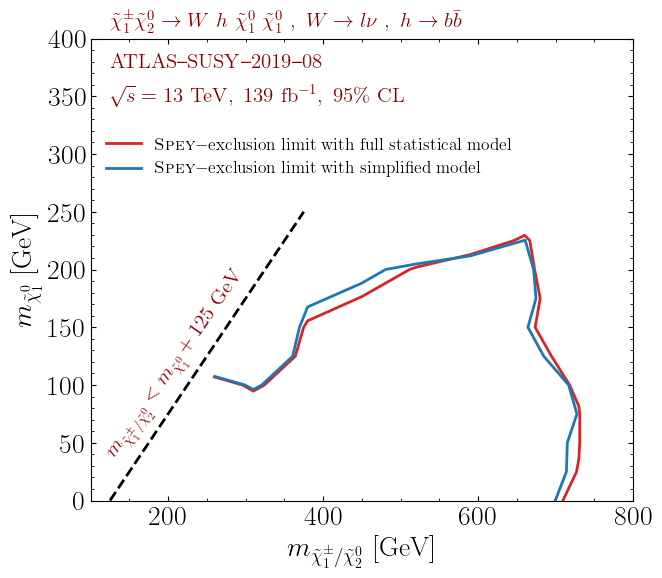
These results can be reproduced by following the prescription above. Note that the red curve does not correspond to the official results, because it is plotted from only 67 mass points; the official limit can be reproduced using the full patch set provided by the collaboration.
Comparison with pyhf’s in-house simplification tool#
The eschanet/simplify tool
(eschanet/simplify; see also the ATLAS PUB note
ATL-PHYS-PUB-2021-038)
implements an alternative path from a pyhf HistFactory
workspace to a compact statistical model. Because its output is itself
a pyhf workspace, it can be loaded directly through the
spey-pyhf interface without going through the converter
described in this page. The two methods solve the same problem,
trading the long list of elementary nuisance parameters for one bin-wise
uncertainty source, but the simplifications they apply are different
and lead to different statistical models. The comparison below is
intended to make the differences explicit so that users can pick the
approximation that matches their use case.
Reference setup#
Let \(\nu_I(\boldsymbol{\theta})\) denote the per-bin total
expected count of the full pyhf model, where
\(\boldsymbol{\theta} = (\theta_1, \dots, \theta_N)\) collects all
elementary nuisance parameters. After fitting the full model one
obtains the maximum-likelihood estimate
\(\hat{\boldsymbol{\theta}}\) and the corresponding parameter
covariance \(\mathbf{C} \in \mathbb{R}^{N\times N}\) (with
\(\sigma_i \equiv \sqrt{C_{ii}}\) and Pearson correlation
\(r_{ij} = C_{ij}/(\sigma_i\sigma_j)\)). The two methods use this
information differently.
eschanet/simplify: post-fit linearised error propagation#
For every parameter \(\theta_i\) the implementation computes a symmetric finite-difference variation of the per-bin expectation:
with \(\hat{e}_i\) the unit vector along \(\theta_i\). In the limit of small \(\sigma_i\) this is exactly the first-order Taylor coefficient \(\Delta_{I,i} \simeq \sigma_i\,\partial\nu_I/\partial\theta_i\). The total per-bin variance is then obtained by linearised error propagation through the post-fit correlation matrix:
equivalent in matrix form to
\(\sigma_{b,I}^{2} = \boldsymbol{\Delta}_{I}^{\mathrm{T}}\,
\mathbf{R}\,\boldsymbol{\Delta}_{I}\), where
\(\mathbf{R}\) is the post-fit correlation matrix and
\(\boldsymbol{\Delta}_{I}\) is the column vector of finite-difference
slopes for bin \(I\). Pairs of pure staterror parameters are
treated as uncorrelated by convention.
The output workspace contains one channel per surviving channel of the
original model, each with a single "Bkg" sample whose nominal yield
is the post-fit prediction
\(\nu_I(\hat{\boldsymbol{\theta}})\) and a single histosys
modifier named totalError with templates
The likelihood evaluated on this workspace is, schematically,
where each \(\theta_I^{\mathrm{tot}}\) is the nuisance parameter
associated with the totalError modifier of bin \(I\) and the
histosys interpolation provides the linear morphing between
\(\nu_I\) and \(\nu^{\pm}_{I}\) consistent with eq.
(9).
spey-pyhf.simplify: Monte-Carlo moment extraction#
The converter implemented here, by contrast, samples \(\tilde{\boldsymbol{\theta}}\) from the constraint \(\mathcal{N}(\hat{\boldsymbol{\theta}}_0^{c}, \mathbf{V})\) and propagates each draw through the full likelihood before estimating the moments of the resulting per-bin distribution:
These moments feed eqs. (2) and (3) to
produce the
CorrelatedBackground or
ThirdMomentExpansion simplified
likelihood, eq. (1). The mapping is fully described in
Methodology above; for the asymmetric variant
the Barlow effective-\(\sigma\), eq. (4), is used
instead.
Side-by-side#
The following table summarises the differences.
Aspect |
|
|
|---|---|---|
Order of approximation |
First-order Taylor expansion of \(\nu_I(\boldsymbol{\theta})\) around \(\hat{\boldsymbol{\theta}}\), eq. (7). |
Non-linear propagation through Monte-Carlo: full evaluation of \(\nu_I(\tilde{\boldsymbol{\theta}})\) for each draw, eq. (11). |
Where the fit is performed |
Global fit of the full likelihood (signal + background, or background-only). |
Background-only profile of a control likelihood \(\mathcal{L}^{c}\) at \(\mu = 0\), eq. (5). |
Parameter covariance source |
Post-fit covariance \(\mathbf{C}\) from MINUIT (HESSE) on the full model. |
Observed Fisher information \(\mathbf{V}\) evaluated via JAX automatic differentiation on \(\mathcal{L}^{c}\), eq. (5). |
Per-bin uncertainty |
Symmetric Gaussian: \(\sigma_{b,I}^{2} = \boldsymbol{\Delta}_{I}^{\mathrm{T}} \mathbf{R}\,\boldsymbol{\Delta}_{I}\), eq. (8). |
First two (optionally three) central moments \((m_{1,I}, m_{2,II}, m_{3,I})\), or the empirical 68 % quantiles for “default.effective_sigma”. |
Bin-to-bin correlation |
Absent. Each bin receives an independent |
Retained in \(m_{2,IJ}\) and propagated to the multivariate-Gaussian constraint \(\boldsymbol{\theta} \sim \mathcal{N}(\mathbf{0},\boldsymbol{\rho})\). |
Skewness / asymmetry |
Not represented; the variable-Gaussian envelope is symmetric. |
Optional via \(m_{3,I}\), eqs. (2) and (3), or via the asymmetric quantile envelope \((\sigma^{+}_I, \sigma^{-}_I)\) of eq. (4). |
Treatment of staterror×staterror correlations |
Forced to zero, regardless of the entry of \(\mathbf{R}\). |
Preserved through the Hessian of \(\mathcal{L}^{c}\) and the multivariate-Gaussian sampling. |
Output format |
A |
A native |
Dominant computational cost |
\(\mathcal{O}(N)\) evaluations of \(\nu_I\) (one symmetric pair per nuisance parameter). |
\(\mathcal{O}(M)\) full-model evaluations, where \(M\)
is |
Relationship in a common limit#
In the regime where the post-fit log-likelihood is well approximated by a multivariate Gaussian in \(\boldsymbol{\theta}\), both methods estimate the same first two moments of \(\nu_I(\boldsymbol{\theta})\). Indeed, linearising \(\nu_I(\boldsymbol{\theta}) \simeq \nu_I(\hat{\boldsymbol{\theta}}) + \mathbf{g}_I^{\mathrm{T}} \delta\boldsymbol{\theta}\) with \(\mathbf{g}_{I,i} \equiv \partial\nu_I/\partial\theta_i\) and sampling \(\delta\boldsymbol{\theta} \sim \mathcal{N}(0, \mathbf{C})\) gives
The eschanet/simplify per-bin variance, eq. (8),
is precisely the diagonal \(I = J\) of this expression with the
gradients replaced by central finite differences. The two approaches
therefore coincide on the diagonal of
\(m_2\), up to the discretisation of the finite difference and
the choice of fit (control vs. global), when the model is locally
linear in \(\boldsymbol{\theta}\) and the elementary nuisance
parameters are jointly Gaussian. They part ways whenever any of the
following is non-negligible:
Non-linearity in \(\nu_I(\boldsymbol{\theta})\) (e.g.
histosysinterpolation outside the linear regime, largenormsysshifts, log-normal lumi-style modifiers): the Taylor expansion drops \(\mathcal{O}(\delta\theta^2)\) corrections that the Monte-Carlo retains exactly.Bin-to-bin correlation: only the off-diagonal \(m_{2,IJ}\) retained by
spey-pyhfcouples bins;eschanet/simplifydecouples them by construction.Skewness / boundedness: positivity of yields, asymmetric
histosystemplates, or visibly skewed post-fit distributions generate non-zero \(m_{3,I}\) and asymmetric quantiles that"default.third_moment_expansion"and"default.effective_sigma"use, but thateschanet/simplifydiscards.
Which approximation to use therefore depends on whether bin correlations
and higher-order effects matter for the analysis at hand. When they do
not, the lightweight pyhf patch produced by eschanet/simplify
is sufficient; when they do, the moment-based reduction implemented
here preserves the relevant information at the cost of an additional
Monte-Carlo pass.
References#
A. Buckley, M. Citron, S. Fichet, S. Kraml, W. Waltenberger and N. Wardle, The Simplified Likelihood Framework, JHEP 04 (2019) 064, arXiv:1809.05548. Defines the simplified likelihood, the moment-matching parameters and the Monte-Carlo extraction procedure used here.
R. Barlow, Asymmetric Errors, arXiv:physics/0406120, Sec. 3.6. Source of the variable-Gaussian effective-\(\sigma\) form consumed by “default.effective_sigma”.
E. Schanet,
simplifypackage (eschanet/simplify). Complementary tool that emits apyhf-compatible JSON patch by freezing the post-fit background into a single sample.
Acknowledgements#
This functionality has been discussed and requested during the 8th (Re)interpretation Forum. Thanks to Nicholas Wardle, Sabine Kraml and Wolfgang Waltenberger for the lively discussion.